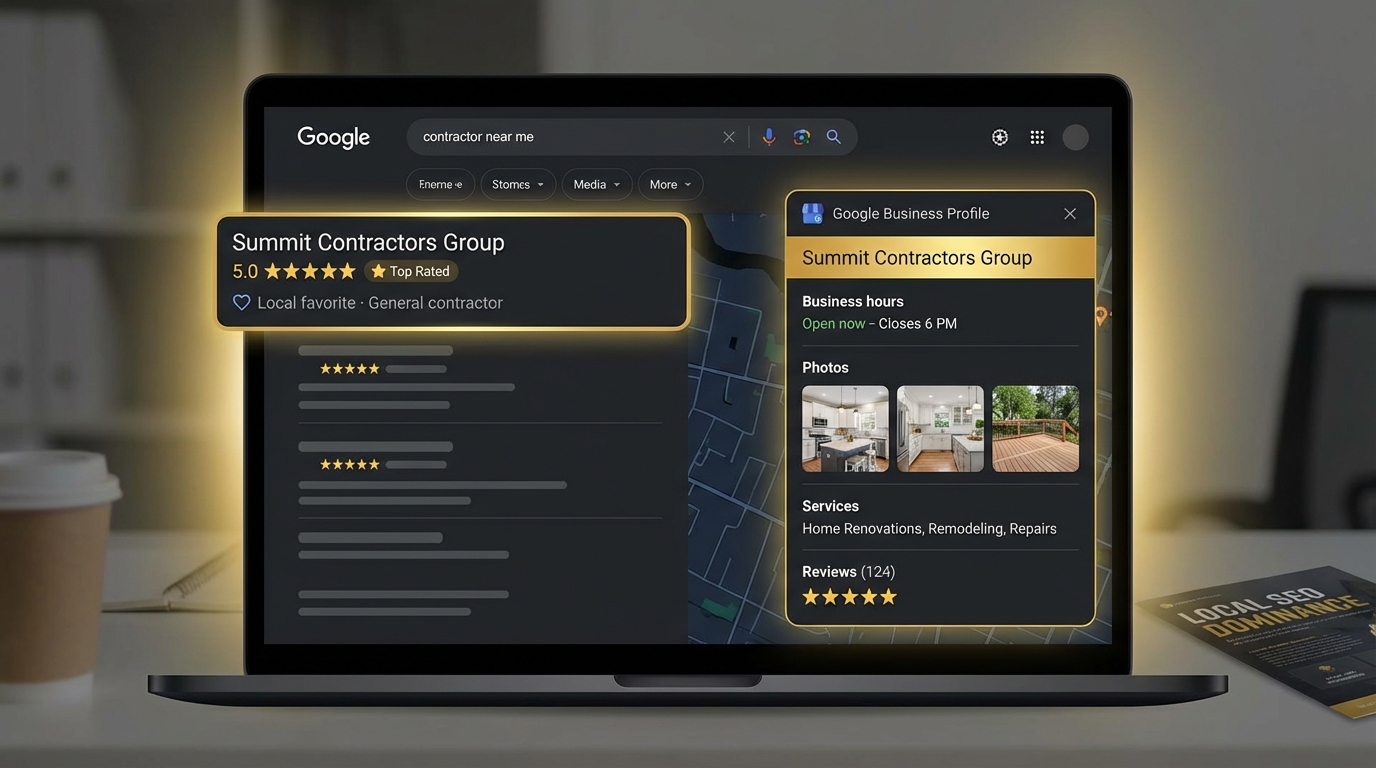
The top 3 Maps results get 70% of clicks. Positions 4-10 are basically invisible.
When a homeowner searches "roofer near me" on their phone, Google shows them a map with three businesses pinned at the top. That's the 3-pack. It's where roughly 44% of all local search traffic goes, and if you're not there, your website's ranking barely matters.
This guide is the tactical playbook for hitting and staying in the 3-pack. Not theory, not fluff. The specific levers Google's local algorithm actually weighs in 2026, and the order we pull them for our clients.
What You'll Learn
1. What the 3-Pack Is and Why It Matters
The "3-pack" (or "local pack" or "Maps pack") is the block of three business results that appear above organic listings when someone searches for a local service. Each result shows the business name, star rating, review count, category, address, and hours.
For contractors, the 3-pack is often the only thing a homeowner sees before clicking. They scan three businesses in 15 seconds and pick one, usually the one with the best combination of proximity and star rating. That's it. That's your funnel.
2. The 3 Ranking Factors That Matter
Google's local algorithm weighs three factors for Maps ranking. Every tactic in this guide falls under one of these:
- Relevance: How well your business matches what's being searched (categories, services, keywords in your profile and reviews).
- Distance: How close you are to the searcher. You can't control this directly but you can expand your ranking radius through content and citations.
- Prominence: How established your business is (review count, citations, backlinks, website authority, GBP engagement).
Distance is mostly fixed. Relevance and prominence are where you compete. For the deeper picture, read our contractor local SEO guide.
3. Google Business Profile Optimization
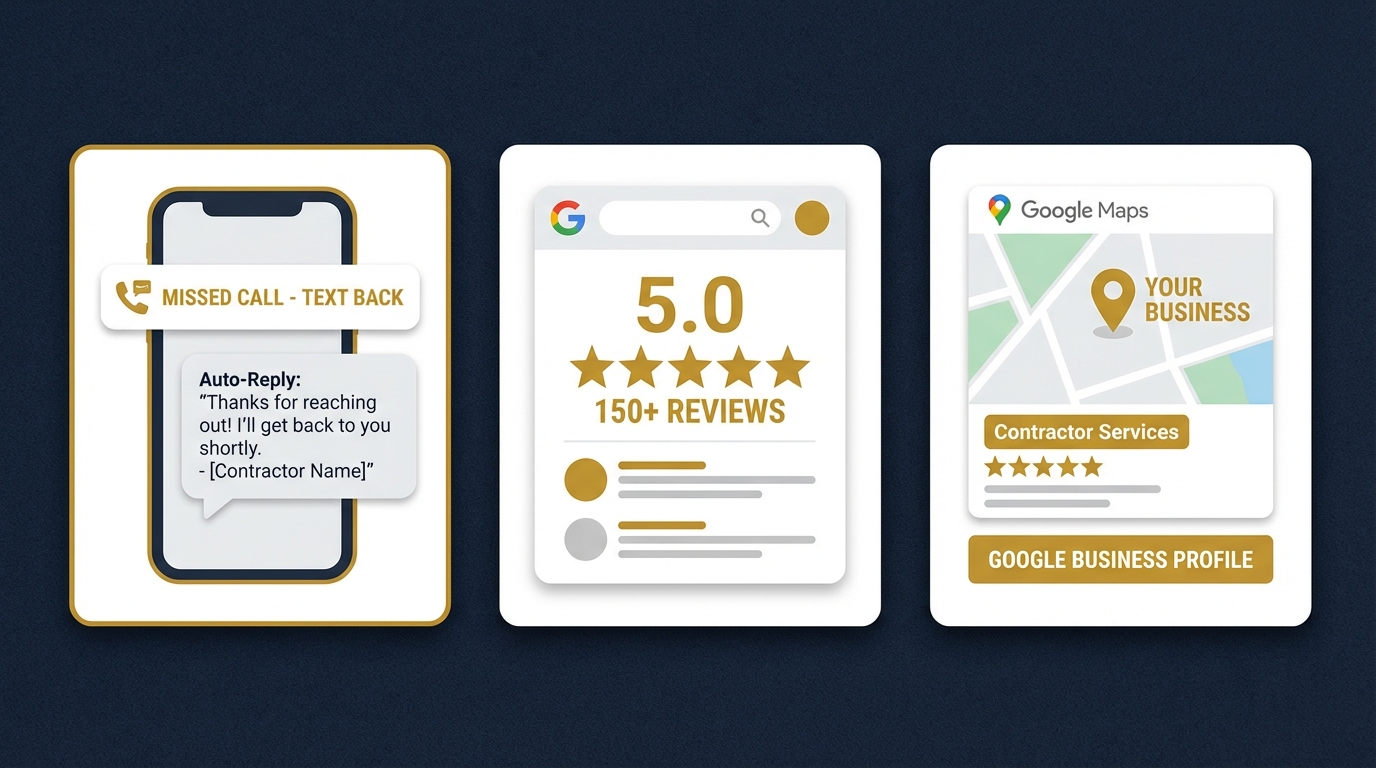
Your GBP is your Maps ranking. Everything else is support.
Your Google Business Profile is the single most important asset for Maps ranking. Optimize these 12 fields and you'll move up faster than you expect:
- Primary category: Be specific. "Roofing contractor" beats "Contractor."
- Secondary categories: Add up to 9, but only ones you genuinely offer.
- Business name: Your real name. Keyword stuffing ("Dallas Roofing Best Contractor") gets you suspended.
- Address: Exact, consistent with your website and all citations.
- Phone: Local number preferred over toll-free.
- Website URL: Your homepage or a dedicated location page.
- Hours: Accurate and updated for holidays.
- Service areas: List every city you serve (up to 20).
- Services: Enter every service you offer with keyword-rich descriptions.
- Business description: 750 characters, include your primary keyword and service area.
- Photos: 25+ to start, then 2-5 new per week forever.
- Q&A: Populate with common questions. Seed the answers yourself.
If this sounds like a lot, our GBP optimization service handles every field and keeps it updated. Full tutorial in the Google Business Profile guide.
4. NAP Citations and Consistency

NAP = Name, Address, Phone. Consistency across the web is a core ranking signal.
NAP citations are mentions of your business name, address, and phone number across directories and websites. Google cross-references these to verify you're a real, established business. Inconsistency (e.g., "123 Main St" on Yelp vs. "123 Main Street" on your site) hurts ranking.
The citation sites to prioritize:
- Google Business Profile (non-negotiable)
- Bing Places
- Apple Maps / Apple Business Connect
- Yelp
- Facebook Business Page
- Better Business Bureau
- Angi / HomeAdvisor
- Houzz (if remodeling)
- Nextdoor Business
- Your local Chamber of Commerce
- Industry-specific directories (NRCA for roofers, etc.)
- Local news sites and business directories
Aim for 30-50 consistent citations in your first 90 days. Use the exact same spelling and format everywhere.
5. Reviews: The Ranking Multiplier
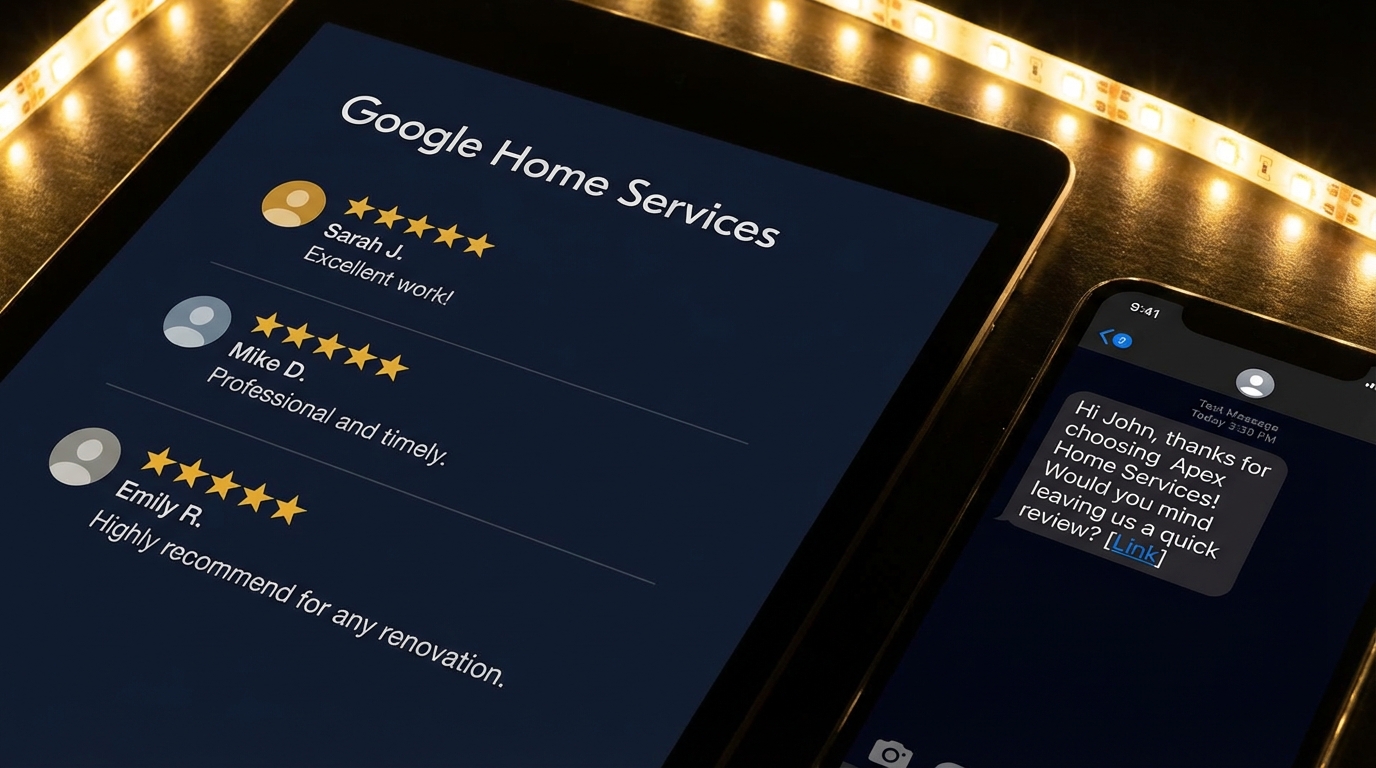
Reviews aren't just trust signals, they're one of the top 5 factors in Map Pack ranking.
Reviews influence ranking in four ways:
- Total review count: Higher = more prominence.
- Average rating: 4.6+ is the threshold for strong ranking.
- Review recency: Fresh reviews signal an active business.
- Keywords in reviews: "They did a great kitchen remodel in Dallas" helps you rank for "kitchen remodel Dallas."
Full system for generating reviews in our article on getting more Google reviews, or use our automated review service.
6. Local Content and Service-Area Pages
Your website feeds your GBP rankings through authority transfer. The stronger your website is for local queries, the better your GBP ranks.
The highest-ROI content structure:
- One service page per service (roofing, siding, gutters, etc.), 800-1,200 words each.
- One service-area page per city you serve, 600-900 words each, with unique content.
- A blog with 1-2 posts per month answering local questions.
- Location schema markup on every page.
This is baked into every Double G contractor website.
Let Us Handle Your Local SEO
GBP optimization, citations, reviews, and local content are all included in the $297/mo system. Book a free demo.
Book Your Free Demo7. Local Backlinks

A few great local backlinks beat 500 generic ones. Think Chamber, local news, suppliers.
Backlinks from other local sites are ranking gold. Focus on quality over quantity:
- Local Chamber of Commerce membership page.
- Local suppliers, material providers, and trade partners.
- Charity sponsorships ("thank you to [Company]" pages).
- Local news (get featured on a community project).
- Local podcasts.
- School or sports team sponsorships.
Skip spam backlinks, Fiverr packages, and PBNs. You'll get penalized.
8. Weekly GBP Posts and Photos

Weekly GBP posts + fresh photos = the ongoing heartbeat your ranking needs.
Google uses GBP engagement as a freshness signal. Post weekly, add photos weekly. Here's what to post:
- Monday: A "job of the week" post with before/after photos.
- Wednesday: A seasonal tip ("Time to clean your gutters before fall.").
- Friday: A customer quote or review highlight.
Add 3-5 photos from recent jobs every week. Geotag them if possible. This alone has moved clients from position 6-8 to position 1-3 in 60 days.
9. How to Track Your Ranking
You can't improve what you don't measure. The three tools we use:
- Local Falcon ($30-$100/mo): Grid-based rank tracking that shows exactly where you rank at each point in your service area.
- GBP Insights (free): Search queries, calls, direction requests.
- Google Search Console (free): For your website's local keyword performance.
Run a Local Falcon scan at the start, then every 30 days. You'll see exactly which neighborhoods you rank in and which you need to work on.
10. Realistic Timeline
Ranking on Maps isn't instant. Here's what to expect if you do everything right:
- Month 1: GBP optimized, 30+ citations built, review system running. No rank change yet.
- Month 2-3: 15-20 new reviews added, weekly posts running. Small ranking lift (2-5 positions).
- Month 4-6: 50+ reviews total, local content live, backlinks building. Ranking in top 5-10 consistently.
- Month 6-12: Top 3 for primary keywords in your home city. Expanding to secondary cities.
- Year 2+: Dominating the map pack in multiple service areas.
Anyone promising you "#1 in 30 days" is either lying or using tactics that will get you suspended. Local SEO is slow and compounding. The good news: once you're in the 3-pack, it's very hard to be knocked out.
For the full marketing context, see the complete contractor marketing guide and our list of contractor marketing mistakes to avoid. When you're ready to skip the DIY path, book a demo.