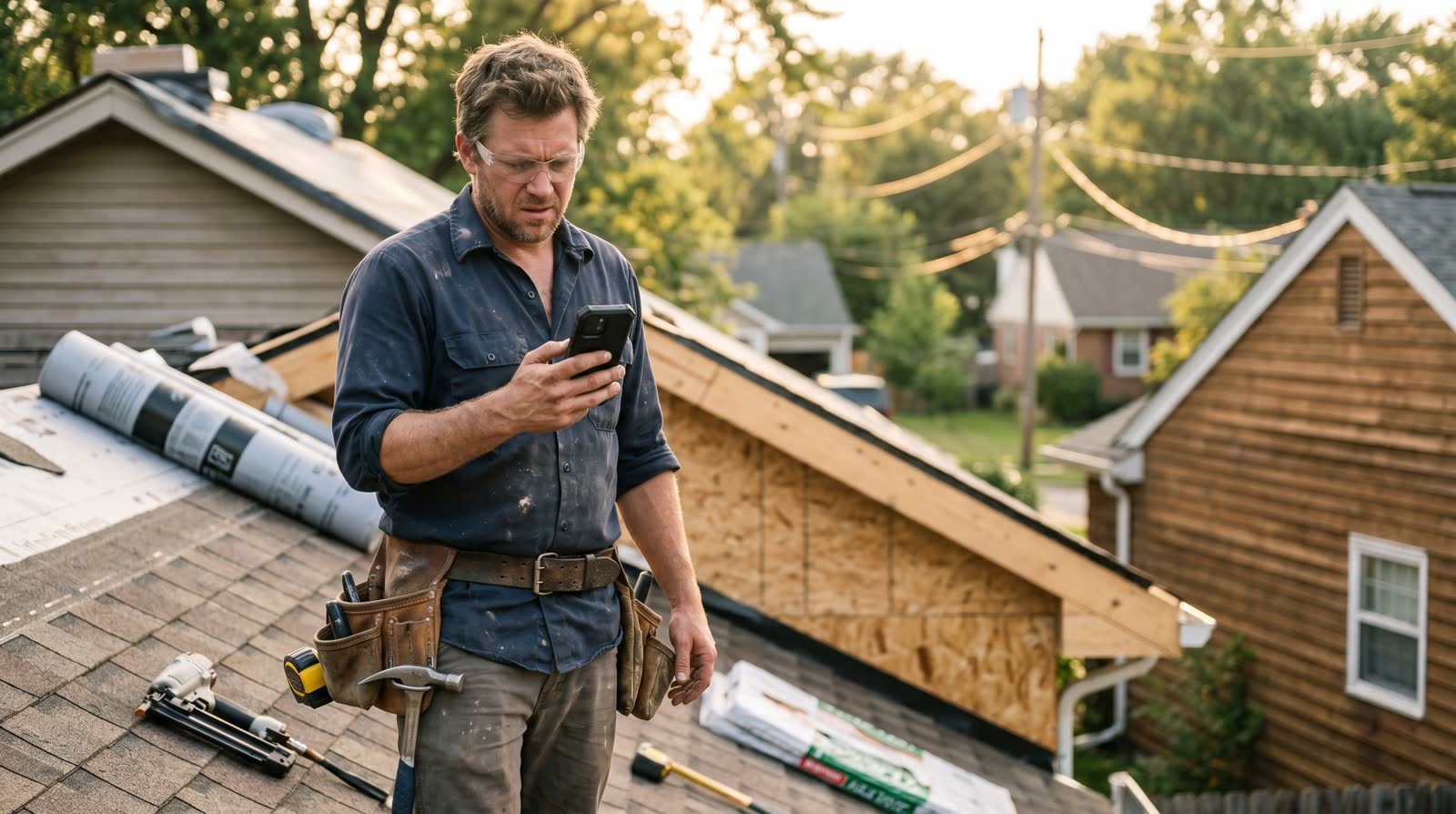

If you're a contractor and your phone rings while you're 20 feet up a ladder, on a roof, or knee-deep in a crawlspace — you're not answering it.
That's not a discipline problem. That's a job problem. The work is the work.
But here's what nobody tells you: roughly 62% of inbound calls to small home-service businesses go unanswered, and the average homeowner who doesn't get a callback within 5 minutes calls the next contractor on the list. That's not a marketing problem either. That's a $30,000–$80,000-a-year leak.
The fix isn't a receptionist. It's a single automated text message that fires the second you miss a call. It's called missed call text-back, and it's the highest-ROI system any contractor can install this year.
Here's exactly how it works, what it costs you to not have it, and how to set it up the right way.
TL;DR
- Most contractors miss 40–60% of inbound calls — and most of those callers hire someone else within 10 minutes.
- Missed call text-back auto-sends a text the moment you miss a call, keeping the lead warm without you lifting a finger.
- Setup takes 24 hours, costs less than one missed job, and typically pays for itself in week one.
The math: what one missed call actually costs a contractor
Let's stop guessing and run the numbers on a typical week.
- Average inbound calls per week for a small contractor: 20
- Average miss rate when you're on job sites: 40–60% (BIA/Kelsey)
- Average ticket size: $1,200 (conservative for trades; remodelers and roofers are 3–10× higher)
- Industry close rate when you respond first: ~50%
So in a normal week, a contractor missing 8 calls and never following up is leaving roughly $4,800 on the table. Multiply by 50 working weeks and you're at $240,000 a year in missed revenue — and that's before we talk about repeat customers, referrals, and review velocity.
Even if you think those numbers are aggressive — cut them in half. You're still at $120k. The cheapest receptionist in America can't fix that. A 30-second text message can.
What "missed call text-back" actually is (in plain English)
Missed call text-back is exactly what it sounds like: when someone calls your business number and you don't pick up, the system instantly sends them a text from that same number.
The text looks like it came from you, because it did — it's tied to your business line. The homeowner sees a real reply within seconds, not 4 hours later when you finally check voicemail.
A typical exchange looks like this:
6:42pm — Homeowner calls. You're on a roof.
6:42pm — Auto-text fires from your number:
"Hey, this is Mike at Double G Roofing — saw you just called. I'm wrapping up a job and can't grab the phone. What can I help with? Quote, repair, or something else? — Mike"6:43pm — Homeowner replies:
"Need a quote on a small leak above the garage."6:44pm — System pings you on your phone. You reply when you're down off the roof.
That homeowner doesn't call your competitor. They're already in a conversation with you.
That's the entire game.
How it works in 4 steps
Under the hood, missed call text-back is a simple chain of events. The good systems make it invisible to you and instant to the customer.

Step 1 — Call comes in. Your business line rings (cell, landline, or VoIP — doesn't matter, as long as it's connected to the system).
Step 2 — Call goes unanswered. After your set number of rings (usually 4–5), the call is flagged as missed.
Step 3 — Text fires automatically. Within 5–15 seconds, your pre-written text goes out from your business number. The homeowner's phone buzzes before they've even put it back in their pocket.
Step 4 — Two-way conversation opens. When they reply, you get a notification on your phone (or your office's). You answer in plain text — no app to learn, no portal to log into. The whole thread lives in one place so you don't lose context.
That's it. Four steps. No new phone, no new line, no learning curve.
3 text-back templates you can steal
The script matters. Generic "Sorry we missed your call, please leave a message" templates kill the magic. Here are three that work, by trade.
Roofing / exterior
"Hey — this is [Name] at [Company]. Saw you called. I'm on a roof and can't pick up. Quick question so I can help fast: is this a repair, a full replacement, or storm damage? Shoot me a text and I'll get back to you within the hour."
Plumbing / HVAC (urgency-aware)
"Hey, this is [Name] at [Company]. Couldn't grab the phone — on a service call. Is this an emergency (leak, no heat, no AC) or a quote? If emergency, text 'URGENT' and I'll call you back in 10 min. Otherwise, tell me what's going on and I'll get you on the schedule."
Remodeling / general contracting
"Hey — [Name] at [Company]. On a job site, missed your call. Are you looking for a quote on a project, or following up on something we already discussed? Text me a few details and I'll get back to you tonight."
Three rules:
- Use your real name. It feels human. "Sorry we missed your call" feels like a robot.
- Ask one specific question. It moves the conversation forward instead of waiting for them to type a paragraph.
- Set a time expectation. "Within the hour," "tonight," "by tomorrow morning." Anchors trust.
Why DIY (Zapier + Twilio) usually fails contractors
Every contractor I've talked to who tried to build this themselves ended up scrapping it within 60 days. Here's why:
- Phone number issues. Twilio numbers can't always text from your existing business line. Customers see a different number, get suspicious, and don't reply.
- A2P 10DLC compliance. As of 2024, U.S. carriers require business texting numbers to be registered. Skip this and your texts silently get filtered to spam — you'll never know they didn't land.
- No two-way inbox. Zapier can fire a text. It can't show you a thread. You'll get replies bouncing into a Google Sheet you'll never check.
- No fallback. What happens if the customer texts back at 9pm? Without an inbox, scheduling, and tagging, leads fall through the cracks.
The savings on a DIY build (~$30/mo) get eaten by one missed lead. It's the wrong line item to optimize.
What to look for in a done-for-you system
If you're evaluating providers, this is the checklist:
- Texts come from your existing business number (not a new Twilio line)
- A2P 10DLC registered so messages don't get filtered
- Two-way inbox in one place (web + mobile app)
- Customizable text templates per trade or service type
- Auto-tags new leads so you can follow up later
- Connects to your review request flow (after the job, the same system should ask for a Google review)
- Month-to-month, not a 12-month contract
That last one matters. A system that works doesn't need a contract to keep you.
Real-world example
A general contractor in central Florida — call him Dave — was running about 25 inbound calls a week. He tracked it for one month before installing a text-back system: he answered 11, missed 14, and converted 3 of the 14 missed calls into eventual jobs (from voicemails he returned the next day).
After installing missed call text-back:
- Same 14 missed calls per week
- 9 of 14 replied to the auto-text within 5 minutes
- 5 of those 9 became booked estimates
- 3 became signed jobs
He went from 3 jobs/month off missed calls to 12 jobs/month. Average ticket $4,200. That's roughly $37,800/month of revenue that was previously dialing his competitor.
The system cost him $297/month. The math doesn't need a calculator.
Common mistakes contractors make with text-back
Even with the right tool, here's what kills the ROI:
- Generic templates. "We'll get back to you soon" is worse than nothing.
- No follow-up sequence. If they don't reply to the first text, a second message 24 hours later catches another 15–20% of leads.
- Letting the inbox pile up. The whole point is fast response — set a notification on your phone and treat the inbox like calls, not email.
- Not connecting it to a review funnel. The same system should ask happy customers for a Google review the day after the job. That's how you stack the second-most-valuable asset (reviews) on top of the first (leads).
- Skipping A2P registration. This isn't optional in 2026. Skip it and your texts quietly disappear into spam folders.
FAQs
Will customers think the auto-text is spam?
No — when it's written like a human ("Hey, this is Mike, on a roof") and comes from your real business number, it reads like you actually texted them. The complaints we see are from generic "Sorry we missed your call" templates.
Does it work with my existing phone number?
Yes, with the right system. The number gets enabled for both calls and texts (called "number provisioning"). You don't change carriers or get a new number.
What if I don't text — I'm a phone guy?
You don't have to type. Most contractors set the system to ping their phone, then they call the lead back when they get a free moment. The auto-text just keeps the lead warm in the meantime.
How fast can it be set up?
A done-for-you system is live in 24–48 hours, including A2P registration. DIY builds (Twilio + Zapier) take 1–2 weeks if you've never done one before.
What does it cost?
DIY runs $30–$80/month plus your time and ongoing maintenance. Done-for-you systems range from $97 to $500+/month depending on what's bundled. At Double G, missed call text-back is included in our $297/month all-in stack — alongside your website, review funnel, GBP optimization, and reputation dashboard.
The bottom line
Every contractor in America is leaving money on the table the same way: a phone ringing while their hands are full. The difference between the contractors who scale and the ones who plateau is whether something is working for them while they're working.
Missed call text-back is the cheapest, fastest, highest-ROI system you can install this year. It pays for itself in week one. And once it's live, you'll never go back.
If you want this built and live for your business in 5–7 business days — included with your website, 5-star review funnel, and reputation dashboard for $297/month, month-to-month — book a free 15-minute demo and we'll show you exactly how it'll look on your number.
Stop letting missed calls become missed jobs.
Book Your Free Demo →